

A recent delivery at the post office included two copies of the Daily Star, a British tabloid and self-proclaimed ‘Home of Fun Stuff’.


Both headlines link the development of technology, artificial intelligence and genetic engineering respectively, to these mysterious ‘boffins’.
Apparently, the term is a staple in the journal’s lexicon:

But who are these masterminds of global change, really?
Boffins: A Brief History
The Cambridge Dictionary defines ‘boffin’ as UK slang for ‘a scientist who is considered to know a lot about science and not to be interested in other things.’ Urban Dictionary elaborates, describing it as ‘an affectionate term, but with some practical fighting man’s scorn for the academic brain worker’.
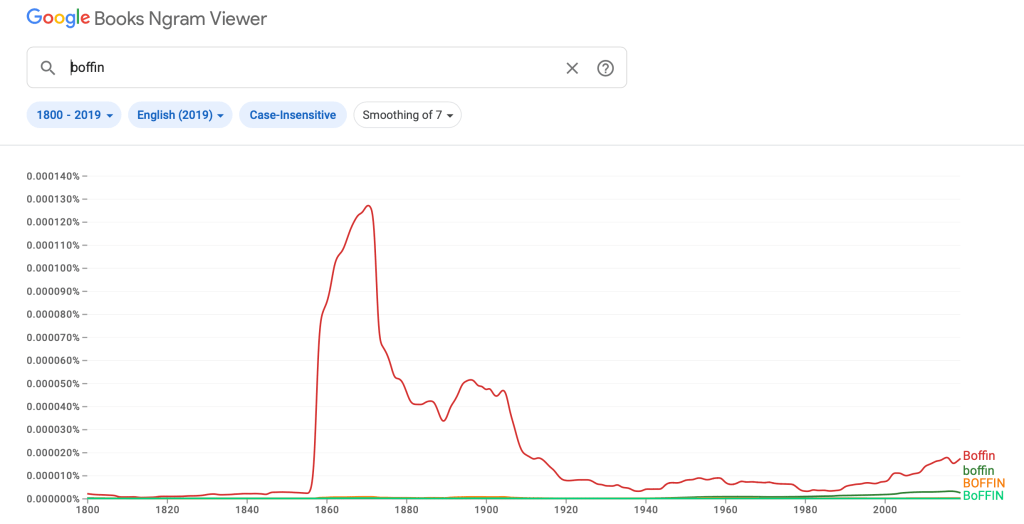
Google N-Grams Viewer shows the term’s emergence in discourse around mid-C19, peaking in popularity in 1870. These metrics culturally track with the Victorian preoccupation with scientific progress.
Wikipedia further nuances the term’s connotation, linking it to military involvement throughout C20. In World War II, boffins, crucial to war efforts, collaborated closely with the military, lending their scientific and technical expertise.
Post-Cold War, the term shed its martial connotation, partially due to the influence of popular culture and media. . Instead, it came to evoke the figure of the ‘mad scientist’. While late C20 industry valued boffin-like qualities – detailed research, deep knowledge, technical skills – such workers were no longer labeled as such. By C21, ‘boffin’ had become a pejorative.
The Trouble with Boffins
Recently, The Daily Star faced criticism for its persistent use of ‘boffin’. In 2023, the Institute of Physics (IoP) launched the ‘Bin the Boffin’ campaign, urging UK tabloids to abandon the term.
[IoP] commissioned a survey of 2,500 people who said the word conjured-up a deeply stereotypical image: a posh, male, often bald and almost certainly wearing a long white coat and thick rimmed specs. In the survey, 80 per cent of young people said they saw boffin as an insult.
Camden New Journal
Initially, I agreed, arguing that the ‘boffin’ label obfuscates the complex networks of power and resources behind scientific breakthroughs. Let’s return to the invisible boffins from our headlines. George Church, for instance, may personify the modern ‘boffin’ in de-extinction efforts, but Colossal represents more than one man’s mammoth ambition; it embodies significant implications for gene editing and assisted reproduction technologies. Similarly, calling OpenAi’s Sam Altman a ‘boffin’ playfully muffles the bang of the LLM heard ‘round the world.
However, I find a certain resonance with Watson-Watt’s 1953 portrayal of the ‘boffin’: ‘He is a middleman, but he is a middleman who can effect enormous economies and enormous increases in efficiencies.’ In 2023, MarketDigits valued the global CRISPR market at USD 3.21 billion, while Statista estimated the generative AI market at USD 44.89 billion. The boffins are effecting enormous economies. Both are growing rapidly, with the former predicted to hit USD 11.1 billion by 2030 and the latter capable of reaching USD 1.3 trillion by 2032. The boffins are effecting enormous increases in efficiencies.
The age of men is over. The time of the boffin has come.
 Desert Wi-Fi Media